One building, every age
Family Dentistry
There is no need to run all over town to find a quality dentist for each member of your family. From toddlers to the elderly, we care for people of all ages, in the same building, with most insurance accepted.
Chapter 01
A cracked tooth on a Friday morning
A dental emergency does not wait for a convenient week. We handle emergencies and consultations in this same building, with the same three dentists who see you for a routine cleaning. Call (419) 782-7950, tell whoever answers it is urgent, and the desk will find a slot rather than putting you on a list for Monday.
Some cracked or badly decayed teeth can be saved with a filling, a crown or root canal therapy. Others genuinely cannot, and a simple extraction is the honest answer rather than a treatment that will fail in six months. Which one applies is something the dentist tells you plainly once they have actually looked, not something guessed over the phone.
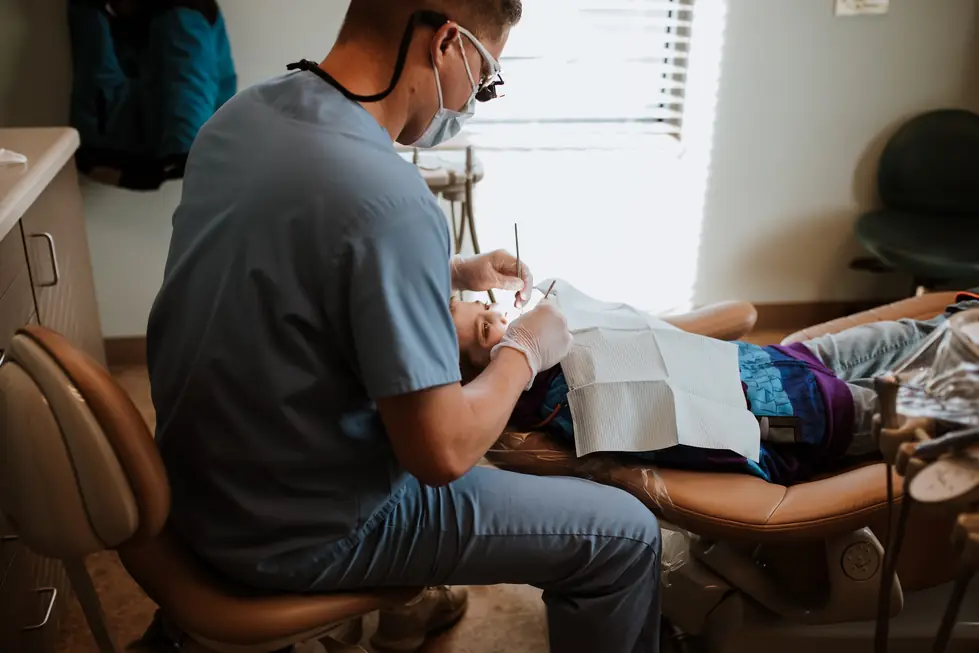
A Defiance Dental Group dentist treating a child patient in a real treatment room
Root canal therapy, plainly
Root canal therapy is what happens when the soft tissue inside a tooth, the pulp, is infected or badly inflamed and a filling alone will not fix it. The dentist opens the tooth, removes that tissue, cleans and shapes the space inside the root, and seals it back up. The point is to stop the infection and keep the tooth in your mouth instead of pulling it.
A tooth that has had root canal therapy is usually more brittle afterward, because it no longer has its own blood supply feeding it. That is why a crown often follows: it is the cap that lets you actually chew on that tooth again without it cracking under normal use.
Chapter 03
Crowns, fillings and dentures
A filling repairs a small area of decay or a chipped edge. A crown covers a tooth that has lost too much structure for a filling to hold, whether from decay, a large old filling failing, or a root canal. Both are done in-house, by the same dentist you already know.
Dentures replace teeth that are missing altogether, whether it is a few or all of them. Getting a well-fitting set is not a single appointment: impressions are taken, the fit is checked, and adjustments are made until the denture sits properly and you can actually eat and speak with it, rather than tolerate it.
A denture that has been in for a while can also loosen as the gums and jawbone underneath change shape, which is a normal part of wearing one and not a sign anything went wrong at the fitting. Bringing that in gets it relined or adjusted rather than left to rub.
Invisalign for adults who were never straightened as kids
Invisalign moves teeth with a series of clear removable trays instead of metal brackets and wires. You swap to the next tray in the series roughly every one to two weeks as your dentist directs, and each one nudges your teeth a little further toward the planned final position.
A lot of the adults who ask about it are not chasing a cosmetic result so much as fixing something that was never dealt with as a kid: a crowded lower arch, a bite that has drifted, teeth that have shifted since a retainer stopped fitting years ago. Because the trays are removable, you take them out to eat and to brush, which is the detail that makes most adults willing to actually wear them.
It starts with the dentist looking at your bite and deciding whether Invisalign is a reasonable way to move your particular teeth, since not every case suits clear trays over traditional options. If it does, the full series is planned out before the first tray ever goes in, so you know roughly how many stages you're committing to from the start.
What a cleaning is actually catching
Preventative care is built around the cleaning appointment, and from toddlers to the elderly, cleanings run on the quiet, unhurried end of the scale here, which is the thing longtime patients bring up first. A hygienist removes the plaque and tartar buildup a toothbrush cannot reach, and the dentist checks for the early decay, cracked fillings and gum changes that do not hurt yet but will if they are left.
For children, the assistant talks through each step of the exam and cleaning as it happens, and parents are welcome to stay in the room. Catching a small cavity or a loose filling at a routine cleaning is what keeps it a filling instead of turning it into the root canal or extraction above.
"Dr. Walz and his staff are always kind and patient with me," says Lorna, a Defiance Dental Group patient.